Reagan's Legacy in a World Transformed by Jeffrey L. Chidester & Paul Kengor
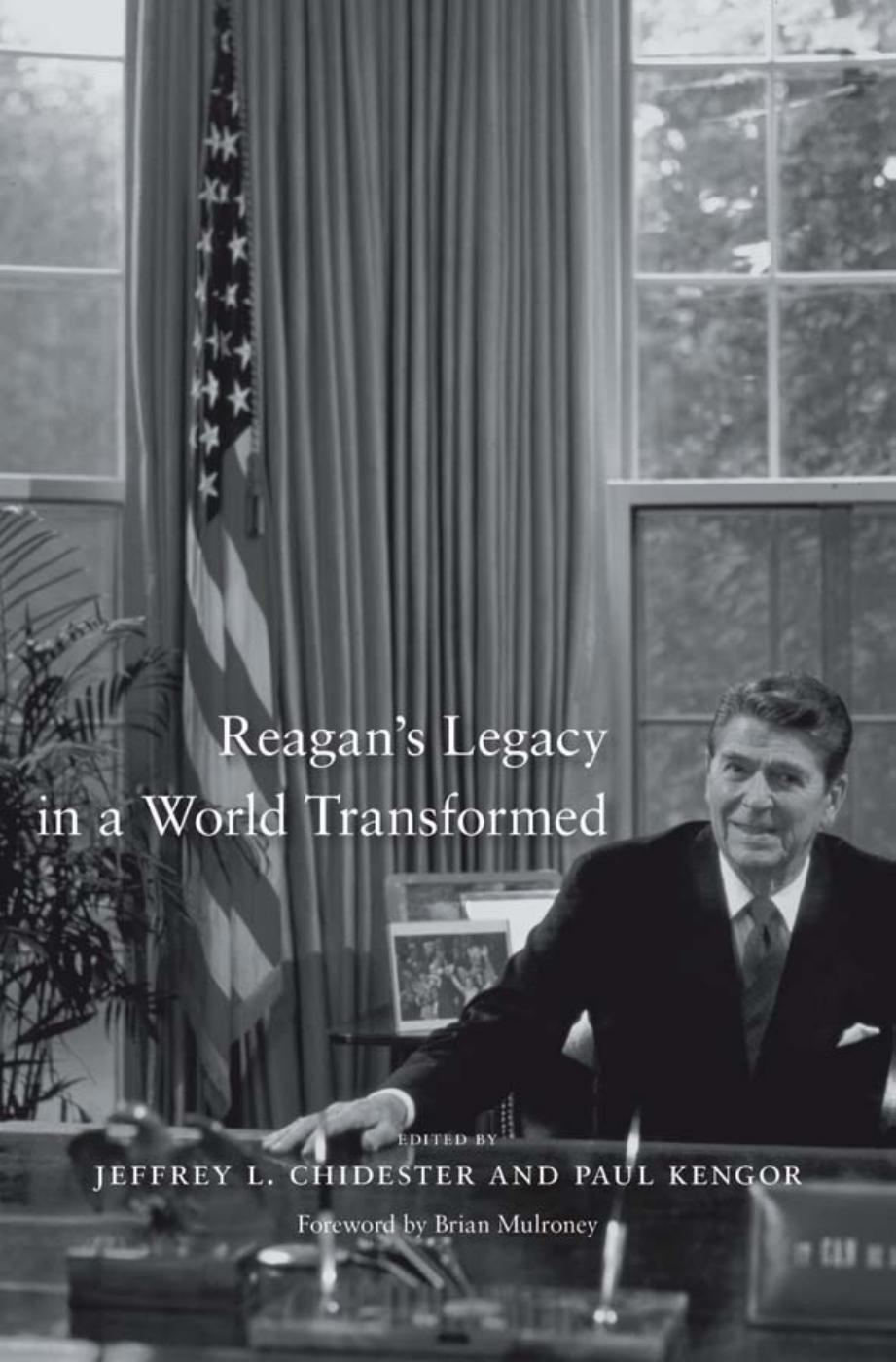
Author:Jeffrey L. Chidester & Paul Kengor [Chidester, Jeffrey L. & Kengor, Paul]
Language: eng
Format: epub, pdf
Tags: History, United States, 20th Century, Political Science, International Relations, General, Public Policy, Economic Policy, American Government, Executive Branch
ISBN: 9780674967694
Google: pjXBBwAAQBAJ
Goodreads: 23503017
Publisher: Harvard University Press
Published: 2015-01-15T13:10:07+00:00
Willingness to Negotiate: Prepresidency
The Soviets themselves witnessed an early indication of Ronald Reaganâs willingness to negotiate in a brief but telling moment in June 1973. At the invitation of President Richard Nixon, Soviet leader Leonid Brezhnev visited the United States. Among his stops, he stayed as a guest in Nixonâs private home in California. Nixon arranged a gala reception to which the âflower of California âhigh societyâ had been invited,â as Andrey Gromyko remembered it. The California governor, Ronald Reagan, was among the guests. There was a long queue waiting in line to briefly shake hands with the Soviet delegation, which featured Brezhnev, Gromyko, and Anatoly Dobrynin, ambassador to the United States. These were precisely the men that Reagan often said were hell-bent on âworld domination.â Nonetheless, Reagan cordially shook hands and quickly said to the three men: âRepresentatives of our two countries should meet each other.â32
At this point, still long before his presidency, Reagan had already spent 20 years lambasting the Soviet Union as a diabolical slave state. Nonetheless, his choice of words to the Soviet leadership at that brief moment focused not on Soviet criminality and misdeeds, but on dialogue. That short encounter became a symbol of what was to come once Reagan arrived at the White House.
Likewise, another interesting aspect of this encounter was Gromykoâs reaction. The communist ideologue was struck that Reagan had âmade plain his warm feelings toward us.â33 It was the same warm feeling that Gromykoâs comrades would sense throughout the 1980s, as Reagan charmed them in private meetings, albeit eviscerating their system in public statements.
Reagan was elected governor in 1966. Then and prior, he argued that the key to peace was a strong defense, which offered both preparation against an aggressor and the ability to negotiate peace. In the 1960s and 1970s, he made innumerable statements calling for increased defense spending for precisely such purposes.34 âWhile we work for peace among men of good will,â said Reagan in July 1968, âwe must rebuild and maintain our strength; building peace will take time and strength is the currency which can buy that time.â35 In an October 1972 statement, he said: âLet me make it perfectly clear that along with a willingness to negotiate, America can best protect the peace by maintaining a realistic and credible ability to defend itself should the need occur.â36
Such Reagan quotes from this period are too numerous to list here.37 One of the better testimonies was a May 1976 interview with U.S. News & World Report. Said Reagan:
I think we have to make darn sure that we improve our military position to the point that weâre not second best [to the Soviet Union], so that we can be truly dealing for peace through strength.⦠If the U.S. would do this and the Soviets see this demonstration of will, they might say: âOh, wait a minute. If weâre going to keep up an arms race, this is going to go on forever and we canât catch them or match them.â Then I think you could have legitimate reduction of arms.
Download
Reagan's Legacy in a World Transformed by Jeffrey L. Chidester & Paul Kengor.pdf
This site does not store any files on its server. We only index and link to content provided by other sites. Please contact the content providers to delete copyright contents if any and email us, we'll remove relevant links or contents immediately.
The Vikings: Conquering England, France, and Ireland by Wernick Robert(84384)
Ali Pasha, Lion of Ioannina by Eugenia Russell & Eugenia Russell(40321)
The Conquerors (The Winning of America Series Book 3) by Eckert Allan W(37986)
The Vikings: Discoverers of a New World by Wernick Robert(37007)
Cecilia; Or, Memoirs of an Heiress — Volume 1 by Fanny Burney(32638)
Cecilia; Or, Memoirs of an Heiress — Volume 2 by Fanny Burney(32013)
Cecilia; Or, Memoirs of an Heiress — Volume 3 by Fanny Burney(31997)
Empire of the Sikhs by Patwant Singh(23138)
The Secret History by Donna Tartt(19311)
Hans Sturm: A Soldier's Odyssey on the Eastern Front by Gordon Williamson(18652)
Cat's cradle by Kurt Vonnegut(15446)
Pimp by Iceberg Slim(14686)
Sapiens: A Brief History of Humankind by Yuval Noah Harari(14466)
Norse Mythology by Gaiman Neil(13459)
Talking to Strangers by Malcolm Gladwell(13445)
Leonardo da Vinci by Walter Isaacson(13413)
4 3 2 1: A Novel by Paul Auster(12520)
Underground: A Human History of the Worlds Beneath Our Feet by Will Hunt(12148)
The Radium Girls by Kate Moore(12096)
